Peristaltic Pumps: How They Work and When to Choose Them
For Water Treatment Chemical Dosing
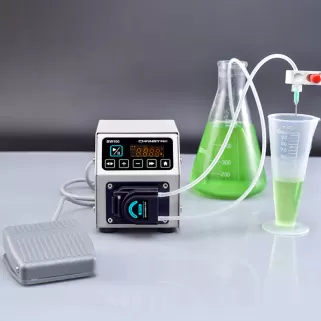
A peristaltic pump is a positive displacement pump with no valves or seals in the fluid path. A motor-driven rotor with rollers or shoes compresses a flexible tube against a housing, forming a sealed "pillow" of liquid. As the rotor turns, that pillow is pushed to the discharge, while the tube's restitution behind the roller creates vacuum to self-prime. The chemical touches only the inside of the tube.
That single fact makes it superior to diaphragm and solenoid metering pumps for most U.S. water treatment dosing duties.
Consider the typical American chemical palette: sodium hypochlorite (12.5%) off-gasses chlorine and vapor-locks diaphragm pumps; sulfuric acid and caustic soda (NaOH) attack seals and check valves; ferric chloride and alum are abrasive and carry suspended solids; anionic flocculant (PAM) is highly viscous and shear-sensitive — a gear or diaphragm pump will shred its polymer chains and ruin flocculation.
Beyond basic specifications, it is important to understand the practical engineering limits of peristaltic pumps.
1. Pressure & Suction: Standard tube pumps are low-pressure devices, typically 2-3 bar continuous, while reinforced hose pumps reach 15 bar. But their suction lift is unmatched — up to 9m dry, and they can run dry indefinitely. For hypochlorite, which constantly outgasses, this eliminates the need for degassing valves and prevents loss of prime.
2. Pulsation & Viscosity: Flow is inherently pulsatile. At low flows (<10 mL/min), pulsation is most pronounced and may require a pulsation dampener for analyzers. Conversely, adaptability to high viscosity is a strength: peristaltic pumps handle up to ∼40,000 cP and soft solids without clogging, where solenoid pumps fail.
3. Control Boundaries: In the low-flow regime, accuracy depends on tube bore and RPM and will drift as the tube fatigues. In the high-flow regime, tube life — not motor power — is the limiting factor, dropping from 1,000+ hours to <200 hours at max speed.
From a compliance standpoint, this design directly addresses EPA Risk Management Program (RMP) and OSHA PSM requirements for hazardous chemicals. The fully contained, leak-free fluid path with no dynamic seals drastically reduces operator exposure to chlorine gas, corrosives, and ferric chloride, simplifying secondary containment and safety shower/eyewash planning.
Dosing Accuracy: Flow Control, Calibration, and Pulsation Dampening
Dosing accuracy is the #1 KPI for water treatment chemical feed. With peristaltic pumps, accuracy is not fixed — it drifts. Four factors dominate:
1. Speed Control: Flow is directly proportional to RPM. Use a brushless DC or stepper motor with a closed-loop encoder, not a cheap AC motor, to hold ±0.2% speed stability.
2. Tube Bore Tolerance: Even 0.1mm ID variance changes flow by 3-5%. Always use precision-extruded tubing (PharMed, Norprene) and log lot numbers.
3. Temperature Elasticity: Silicone and PVC soften in summer heat. In Texas or Arizona, a 15°C rise can swell ID and increase flow by 2-4%. In winter, tubes stiffen and flow drops.
4. Head Wear: As the tube fatigues, its restitution weakens. After 500 hours, expect a 5-10% negative drift if not recalibrated.
Peristaltic flow is pulsed. For analyzers, pH loops, and RO antiscalant injection, raw pulsation causes PID hunting.
Inline Pulsation Dampener: Air-charged bladder type, installed within 10x tube diameters of discharge. Cuts pulsation by 90%.
Pulsation Chamber: Simple vertical chamber that traps air as a cushion — low-cost for hypochlorite.
Dual-Head Phasing: Two pump heads 180° out of phase to cancel pulses, ideal for continuous polymer feed.
Actionable Calibration Procedure (Gravimetric Method):
1. Prime with actual chemical at operating temperature for 5 minutes.
2. Weigh: Pump into a beaker on a 0.1g scale for 60 seconds at 50% and 100% setpoint. Do 3 repeats.
3. Calculate: Actual Flow (mL/min) = Weight (g) / Specific Gravity / Time.
4. Verify: Compare both instantaneous flow and cumulative flow over 10 minutes.
5. Document: Record tube hours, temperature, and lot number.
Seasonal Correction in the U.S.: Recalibrate at season change. In northern states, winter fluid viscosity rises, and tube hardens — expect -3% error. In southern summer, expect +3% error. For EPA compliance reporting, maintain a log.
Acceptance Tolerance for O&M: For municipal dosing, acceptable is ±2% of setpoint after calibration, ±5% before recalibration trigger. For pH adjustment under NPDES permits, hold ±3% and calibrate weekly.
Selecting Tubing and Materials: Chemical Compatibility and Temperature Limits
Choosing the tube is 90% of peristaltic pump success. Use this decision flow: Chemical → Concentration → Temperature → Tube Material → Life Expectancy.
Quick Compatibility Matrix for U.S. Water Treatment:
Chemical | Preferred Tube | Max Temp | Typical Life |
Sodium Hypochlorite 12.5% | Norprene (Thermoplastic Elastomer), PharMed BPT | 50°C | 500-800 hrs |
Chlorine Dioxide | PTFE-lined, Viton (FKM) | 80°C | 300-600 hrs |
Sulfuric Acid <75% | Viton, Chem-Sure (PTFE composite) | 60°C | 600-1000 hrs |
Ferric Chloride / Ferric Sulfate | Thick-wall Norprene, Natural Rubber hose | 45°C | 800-1200 hrs |
Organic Flocculant PAM | Silicone (low shear), PharMed | 40°C | 1000+ hrs |
Sodium Bisulfite 38% | EPDM, Norprene | 50°C | 700-1000 hrs |
Avoid PVC for hypochlorite and acids — it hardens and cracks within weeks in warm plants.
High concentration + high temperature = exponential wear. Example: 12.5% hypochlorite at 25°C gives ∼800 hrs life with Norprene A-60-G. At 35°C in a Florida chemical room, life drops to ∼400 hrs. At 18% bleach, life drops another 40%. Always derate by 50% for continuous 24/7 duty.
How to spot chemical fatigue before it bursts:
· Visual: Tube becomes opaque, yellowed, sticky, or shows longitudinal cracks inside.
· Measurable: OD swells >5% vs new, or flow drops >8% at same RPM without pressure change — elasticity is gone.
· Tactile: Tube feels hard or brittle, does not snap back in <1 sec.
Spare Parts Kit to stock (U.S. practice):
Keep 2 tubes per pump, P/N: e.g., 919.A060.024 for Norprene 6.4mm ID, plus compatible PTFE Tri-clamp fittings and EPDM gaskets. Don't use Buna-N with hypochlorite — it swells. Label tubes with install date and hour meter.
U.S. Safety & Leak Control:
Per OSHA 29 CFR 1910.119 and EPA RMP for chlorine, U.S. plants require: 1) Secondary containment of 110% of the largest drum, chemical-resistant (HDPE) for hypochlorite, 2) PTFE-lined leak sensor under pump, 3) Immediate flush with water — never contain hypochlorite leak with acid, risk of chlorine gas. Use PVC/EPDM seals only, no metal fittings on suction side.
Sizing and Real-World Dosing Examples for Water Treatment
Universal Sizing Template (U.S. units friendly):
Required Pump Flow (GPH) = [Water Flow (GPM) x 60 x Target Dose (mg/L) ] / [ Chemical Strength (mg/L) x 3.785 ]
Chemical Strength: 12.5% bleach = 125,000 mg/L available chlorine. Always use active concentration, not product weight.
Then: Select Tube ID + RPM — Flow ≈ Tube Area x RPM x Roller Volume Factor. Never run >80% max RPM for 24/7 duty.
Example 1: Drinking Water Disinfection - Texas
Need 2 mg/L free chlorine in 500 GPM well water, using 12.5% bleach.
Flow = [500 x 60 x 2] / [125,000 x 3.785] = 0.127 GPH = 0.48 L/H
Selection: 3.2mm ID PharMed tube, 10-50 RPM pump. At 0.48 L/H, you run at ∼35% speed = excellent tube life. Add 4-20mA input from flow meter.
Example 2: Wastewater Flocculant - Ohio POTW
300 GPM secondary effluent needs 1.5 mg/L anionic PAM (0.5% neat solution = 5,000 mg/L). PAM is 8,000 cP.
Flow = [300 x 60 x 1.5] / [5,000 x 3.785] = 1.42 GPH = 5.4 L/H
Selection: Must use low-shear silicone tube, 9.6mm ID, max 30 RPM to protect polymer. Use dual-head pump phased 180° to cut pulsation, which prevents floc shear. Hose pump required due to viscosity.
Example 3: Cooling Tower Algae Control - California
1,200-ton tower, 3,600 GPM recirculation, needs 2 ppm non-oxidizing biocide, 15% active (150,000 mg/L) slug dose 2x/week.
Flow = [3,600 x 60 x 2] / [150,000 x 3.785] = 0.76 GPH = 2.9 L/H for 2 hours
Selection: Portable dosing skid: 12V peristaltic with 6.4mm Norprene tube, 110% secondary containment tote, battery timer. Tube bore 6.4mm allows 0.5-6 L/H range, covers shock dose.
Final Selection Check:
1. Is required flow <80% pump max? If not, go up one tube size.
2. Is discharge pressure <2 bar for tube pump, <8 bar for hose pump?
3. Is tube compatible with chemical AND temperature derated?
Temporary / Portable Skid Tip: For U.S. seasonal or emergency reuse pilots, spec a skid with a 30-gallon day tank, leak sensor, and NEMA 4X enclosure. Keep suction lift <3 ft for hypochlorite to avoid cavitation.
Ready to Size Your Pump Right?
Stop guessing tube life and dosing accuracy.
Get your free, no-obligation dosing package in 24 hours:
· Request a Free Site Assessment - we review your chemical, pressure, and control signal
What you'll receive: Material compatibility report, loaner pump for 14-day trial, third-party test data for hypochlorite/acid duty, and a firm quote with spare tube kit.
[Get My Dosing Calculation] [Talk to a Dosing Engineer]
Just send: Chemical Name + % + Water Flow + Target ppm + Discharge Pressure.
What are the advantages of peristaltic pumps compared to diaphragm or solenoid metering pumps for water treatment chemical dosing?
A: Three core advantages that matter in real U.S. plants:
1. No vapor-lock or clogging: Chemical contacts only the tube. Sodium hypochlorite off-gassing that air-locks diaphragm pumps, and ferric chloride solids that clog solenoid check valves, pass through without issue. It can run dry and self-prime up to 9m.
2. Superior chemical resistance & lower shear: No seals, valves, or rotors to corrode from sulfuric acid or caustic. And for shear-sensitive polymers like PAM flocculant, peristaltic is low-shear — diaphragm and gear pumps shred the polymer chain and kill flocculation.
3. Lower total cost of ownership: Only the tube is a wetted wear part, replaced in 2 minutes without tools. No expensive diaphragm kits, no degassing valves. Maintenance cost is 60-70% lower, and per OSHA/EPA, the leak-free, fully contained design significantly reduces operator exposure to chlorine and acids.
Which tubing materials are recommended for common water treatment chemicals like sodium hypochlorite, ferric chloride, sulfuric acid, and polymer coagulants?
For peristaltic pumps, the tube is the pump. Wrong tube = burst in weeks. Here is the U.S. water treatment standard for the 4 chemicals you asked about:
1. Sodium Hypochlorite 12.5% - The hardest to handle
Off-gasses, oxidizes, and crystallizes.
Recommended: Norprene® A-60-G [Thermoplastic Elastomer] is the #1 choice; PharMed® BPT as a premium option.
Avoid: Silicone - swells and fails, PVC - hardens, Natural Rubber, Viton.
· Why: Norprene resists chlorine attack and has low gas permeability.
· Limits: Max 50°C / 122°F. At 25°C, you get 500-800 hrs life. At 35°C in a hot chemical room in Florida/Texas, derate to 300-400 hrs.
· Pro Tip: Use opaque tubing - UV accelerates bleach degradation.
2. Ferric Chloride / Ferric Sulfate - Abrasive + Acidic
High density, contains iron solids, pH <2.
Recommended: Thick-wall Hose Pump with Natural Rubber hose, or Tube Pump with thick-wall Norprene.
Avoid: Silicone - tears, Thin-wall PVC.
· Why: Needs abrasion resistance, not just chemical resistance. Natural rubber is best for slurry-like coagulants.
· Limits: Max 45°C. Life is excellent: 800-1200 hrs because ferric is not as aggressive to elastomer as bleach.
· Pro Tip: Go up one tube wall thickness - e.g., 4.8mm wall instead of 2.4mm.
3. Sulfuric Acid 50-98% - Pure chemical attack
Dehydrates and chars most elastomers.
Recommended: Viton® [FKM] for <75%, Chem-Sure® [PTFE composite] or PTFE-lined tube for >75% or oleum.
Avoid: Norprene, Silicone, Natural Rubber, EPDM, PVC - all fail rapidly.
· Why: Only fluoropolymers resist strong acid. Viton handles 98% H2SO4 up to 60°C.
· Limits: Viton: 60-80°C max. Life 600-1000 hrs. PTFE-lined: 90°C but less flexible, life 300-600 hrs.
· Pro Tip: Use PTFE Tri-Clamp fittings, not polypropylene - acid will crack PP at high conc.
4. Polymer Coagulants - Anionic/Cationic PAM
High viscosity [1,000-40,000 cP] and shear-sensitive. If you shear it, you destroy flocculation.
Recommended: Platinum-cured Silicone or PharMed® BPT - Low Shear
Avoid: Norprene and Viton - high friction coefficient shreds polymer chains.
· Why: Silicone has ultra-low friction and soft compression, preserving long-chain polymer.
· Limits: Max 40°C, pressure <1.5 bar. Run at LOW RPM <30 RPM. Life 1000+ hrs because polymer is chemically benign.
· Pro Tip: Use a 9.6 mmm or 12.7mm ID tube and slow speed, not a small tube at high speed.
Stocking Rule for U.S. plants:
Keep 2 spare tubes per pump with date label. For bleach systems, required by OSHA/EPA RMP best practice: 110% HDPE secondary containment and a leak sensor. Never mix Buna-N seals with hypochlorite - use EPDM.




![Best Peristaltic Pump for Water Treatment Chemical Dosing [2026 Guide]](/data/watermark/20260902/6a97edf4bde65452_361.webp "Best Peristaltic Pump for Water Treatment Chemical Dosing [2026 Guide]")